
BMI Is a Big Fat Lie: Why Body Fat % Matters More
BMI may mislabel health. New research shows body fat percentage predicts risk better. Learn why BMI falls short and what Americans should track instead.
BLOGS
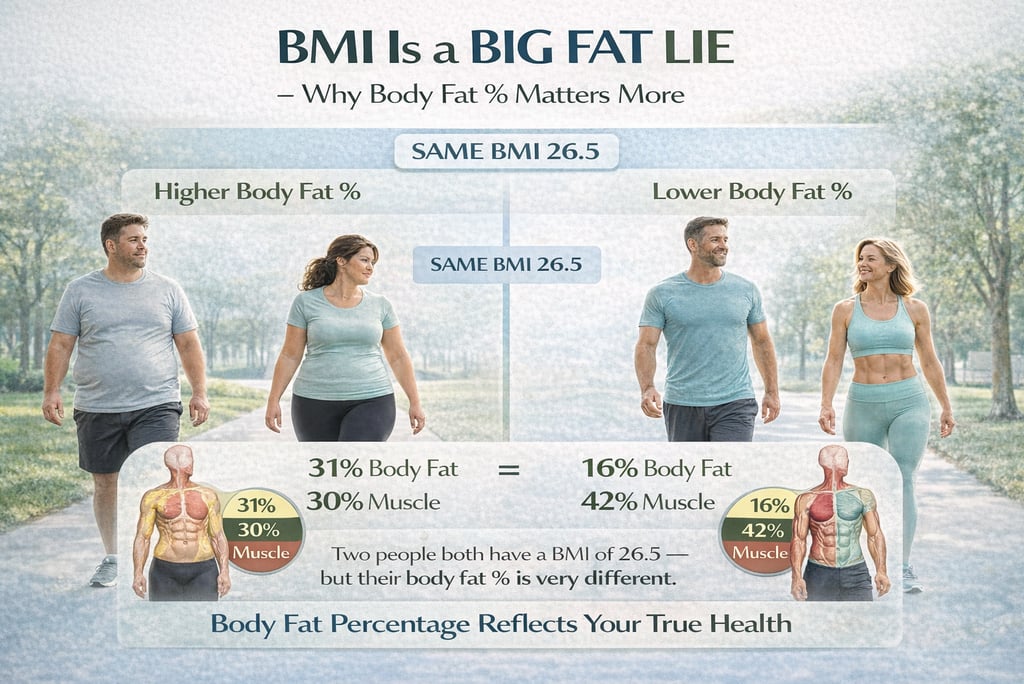
BMI Is a Big Fat Lie - Why Body Fat % Matters More
For decades, Americans have been told to judge their health using one simple number: BMI (Body Mass Index). Doctors, insurance companies, schools, and even fitness apps rely on it to label people as “underweight,” “normal,” “overweight,” or “obese.” But here’s the uncomfortable truth, BMI often gets it wrong.
A growing body of research now shows that body fat percentage is a far more accurate predictor of health risks than BMI. Two people with the same BMI can have completely different health profiles. One may be metabolically healthy, while the other carries dangerous levels of body fat, especially around vital organs.
So if body fat percentage is better, why isn’t it used everywhere in American healthcare? This article breaks down the science, the limitations of BMI, what the new research really says, and what busy Americans should focus on instead.
What Is BMI?
BMI is calculated using height and weight:
BMI = weight (kg) ÷ height² (m²)
It was developed in the 1800s as a population-level statistical tool, not a personal health diagnostic. Yet today, it’s widely used to make individual health judgments.
Why BMI Became Popular in the U.S.
BMI stuck around because it is:
Fast
Cheap
Easy to calculate
Useful for large population studies
But easy does not mean accurate, especially when it comes to individual health.
Why This Topic Matters for Americans
In the United States:
Millions of adults are labeled “overweight” or “obese” based on BMI alone
Muscular individuals are often misclassified as unhealthy
Older adults with low muscle mass can appear “normal” while having high body fat
Insurance premiums and medical advice may be influenced by BMI categories
This creates misdiagnosis, unnecessary anxiety, and missed health risks.
Key Concepts Explained Clearly
BMI Measures Weight, Not Health
BMI cannot tell the difference between:
Muscle and fat
Visceral fat and subcutaneous fat
Athletic builds and sedentary bodies
It only sees total body mass.
Body Fat Percentage Measures Composition
Body fat percentage tells you:
How much of your body is fat
How much is muscle, bone, and water
This distinction matters because excess body fat, not body weight, is what drives most metabolic disease risk.
The Game-Changing New Research (What the Science Shows)
Recent large-scale studies comparing BMI with body fat percentage have found:
Many people with “normal” BMI have high body fat and elevated disease risk
Some people with “overweight” BMI have healthy body fat levels
Body fat percentage correlates more strongly with:
Heart disease risk
Type 2 diabetes
Inflammation
Mortality risk
In simple terms:
BMI misses hidden fat risk. Body fat percentage does not. This phenomenon is often called “normal-weight obesity.”
Why BMI Fails as a Health Predictor
1. It Ignores Muscle Mass
Muscle weighs more than fat. A strength-trained person may have a high BMI but low body fat and excellent metabolic health.
2. It Doesn’t Measure Fat Location
Visceral fat (fat around organs) is far more dangerous than fat under the skin. BMI cannot detect this.
3. It Penalizes Aging Bodies
As Americans age, they lose muscle and gain fat, even if weight stays the same. BMI may look “fine” while health worsens.
4. It Was Never Designed for Individuals
BMI was created for population statistics, not personal medical decisions.
What Body Fat Percentage Gets Right
Body fat percentage reflects:
True fat burden
Muscle preservation
Metabolic health
Real progress during fat loss
It answers the question BMI cannot: “What is your body actually made of?”
How Body Fat Percentage Is Measured
Common Methods in the U.S.
DEXA Scan (Most Accurate)
Medical imaging
Measures fat, muscle, and bone
Expensive but precise
Bioelectrical Impedance (BIA)
Found in smart scales
Convenient and affordable
Accuracy varies
Skinfold Calipers
Low cost
Requires trained technique
Waist Circumference (Simple Proxy)
Strong predictor of risk
Especially useful when combined with weight trends
Why Doctors Still Rely on BMI
Despite better tools, BMI remains common because:
Body fat testing takes more time
Insurance doesn’t always cover advanced measurements
Clinics prioritize speed and scale
Medical training still emphasizes BMI
Healthcare systems are slow to change, even when evidence improves.
What This Means for Weight Loss
Weight Loss vs Fat Loss
BMI rewards weight loss, even muscle loss
Body fat percentage rewards fat loss and muscle preservation
This is why extreme diets can improve BMI but worsen health.
Benefits of Tracking Body Fat Instead of BMI
More accurate health assessment
Better motivation during plateaus
Less shame around scale weight
Focus on strength and function
Healthier relationship with food and exercise
Common Misunderstandings
“BMI Is Useless”
BMI still has value for population trends, but not as a standalone personal health metric.
“Body Fat % Must Be Perfect”
Trends matter more than single readings. No method is flawless.
FAQs
1. Is BMI completely inaccurate?
No, but it is incomplete and often misleading for individuals.
2. What body fat percentage is healthy?
Ranges vary by age and sex, but overall metabolic health matters more than a single number.
3. Can I be healthy with a high BMI?
Yes, especially if body fat is low and muscle mass is high.
4. Can I be unhealthy with normal BMI?
Yes. This is common and often missed.
5. Should doctors stop using BMI?
BMI should be combined with better tools, not used alone.
6. Is body fat testing expensive?
Some methods are, but basic tracking can be affordable.
Final Thoughts
BMI is not a lie because it’s evil, it’s a lie because it’s incomplete. It reduces complex human biology to a single number and often gets health wrong.
Body fat percentage tells a deeper, more accurate story. As research continues to expose BMI’s limitations, Americans deserve better tools to assess health, tools that prioritize composition, strength, and function, not just scale weight.
If your goal is real health, don’t ask, “What does the scale say?”
Ask instead, “What is my body made of?”
Informational Disclaimer
This article is for informational purposes only and does not replace professional medical advice. Consult a qualified healthcare provider for personalized health assessments.
Related Blogs
USA Wellness Pick © 2026


Evidence-Based Health & Wellness Guidance for Americans